I worked on my first remedial cavity wall tie installation job in the summer of 1984. It was a domestic house in Dewsbury, West Yorkshire. The detached house was brick, built with black ash mortar. A Structural Engineer had noticed some slight bulging of the wall and suspected wall tie corrosion was at work. Without a boroscope, we took bricks out to have a look.
There were no corroding ties, just slates across the cavity, which had snapped, due to differential movement between the inner and out skins of brick. The solution was a supplementary cavity wall tie installation. We used double mechanical ties, installed through the brick face (these were the only ones we could find – made by SPIT Fixings). We didn’t carry out any tension testing (didn’t have a test rig – didn’t know how to use one if we had), though the structural engineer did look on, during the work. Thinking back, we didn’t do that good a job, compared to how we’ve refined our wall tie installations over the past twenty five years.
Anyway, within two years I was running a new business, specialising in nothing but wall tie replacement and I was keeping three teams of technicians busy, five days a week.
Wall tie corrosion is old news now; after the mania of the late eighties and nineties.
It’s not a sexy new problem, which surveyors are interested in. It’s under the radar. The number of survey requests is at an all time low.
Trouble is brewing though. The houses which were showing signs of wall tie corrosion in 1985 are twenty six years older than they were then – they were only fifty years old when wall tie corrosion was first noticed, so they’ve aged by another 50%. Bear in mind too, that in the first 25 years of life there was no corrosion – the ties were still protected by a healthy zinc coating or paint. So in effect they are twice as old now, as they were when corrosion first began in earnest. Corrosion begets corrosion, like when you notice it on a seven year old car wheel arch; Not there one day and popping up all over the place on the next. Houses are no different.
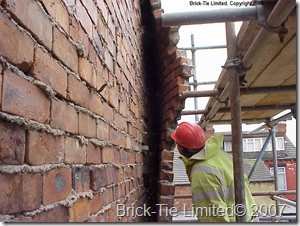
In the past few years we’ve looked at more bulging walls and partial re-builds than in the previous twenty odd years combined. Gables are most at risk and we recently had to deal with one, which was past saving, in Leeds. Other very severe and precarious examples have been found in Wakefield, Sheffield, Harrogate and York too. It’s only a matter of time before someone gets hurt, when an outside leaf is sucked out in a gale.
The very old houses – pre-war ones, usually have thick section ties in, which cause cracking when they rust. Look out for horizontal cracks in bed joints or render. However, post war houses may have thin section wire ties installed. Lots of very poor quality wire ties were imported in the 60’s & 70’s. These rarely cause cracking and can fail without warning. Only an invasive check with boroscope or chisel can check for these. Any wall tie survey must be thorough, because any tie is only as strong as its weakest point; which may not be the bit which is visible in the cavity, via boroscope.
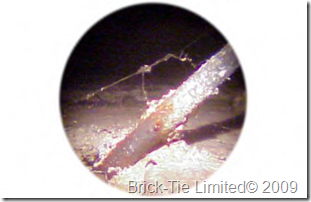
The other parallel problem, which is growing, is cavity wall insulation in houses which are suffering from wall tie corrosion. Once the insulation is in place, corrosion continues, opening up the bed-joints as the ties rust and expand. This lets water into the insulated cavity. The result is ruined insulation which no longer performs properly. Furthermore, cavity wall tie installation in a house which already has insulation present is full of pitfalls. Remedial ties can bridge the cavity by compressing and contaminating the insulation. This leads to damp penetration and condensation, caused by ‘cold bridging’.
Wall tie replacement is a specialist job on any building. However, if the building has cavity wall insulation, extreme care is needed and only the most diligent specialists who have identified the problem and catered for it in their remedial specification should be employed. I see too may ‘specialist wall tie surveys’ where the presence of existing insulation hasn’t even been mentioned, let alone built into the remedial specification. It’ll be interesting to see how these issues develop over the next few years. I’ll keep you informed….
Dry Rot.
PS – if you need a proper wall tie survey in or near Yorkshire, why not try my wall tie company; Brick-Tie Limited?
I wasn’t aware that if I have cavity wall insulation (which I do), then extreme care is needed. Thanks for the info.
Hi,
That’s right. Installing remedial wall ties in a house which is already cavity wall insulated is a real specialist job. Great care is needed to reduce contamination of the insulation during the cavity wall tie replacement work.
Thanks for looking in.
I think cavity insulation in general isn’t all that great. I’ve known people that have had to pay more than double the costs of having installed to have it removed and re-decorated due to several appearances of mould, dampness and condensation.
Hi Jimmy,
Thank you for looking in and commenting on this. In reference to cavity wall insulation I have no real objections to it, though I can’t say I agree that it is ‘not great’. You rightly point out that there are issues which can arise, but these are in the minority. For most installations; when installed correctly, following a proper survey, it is fine.
Of course it doesn’t really cope well with cavity wall replacement work and installation of remedial wall ties after it has been installed, but with care, the problems can be overcome.
I have visited your site and see that you do offer services for clients who may wish to have their insulation removed when they have proven problems with it. This is a useful service Jimmy. I have had to remove the link to your site for now, merely because the site does not identify the company/owners properly in accordance with the regulations. I am sure that your service is great, but we must all try to make sure that ALL web sites offering consumer services have the correct information on for consumers – lack of it is what helps bad companies avoid detection and liability. If you change the site and put the full details on I will be more than happy to provide a link to your insulation removal service.
best wishes in your business and thanks for your input Jimmy.
Bryan.